Showing posts with label Integrative Medicine. Show all posts

Saturday, 28 December 2013

Veterinarian's Seminar at India International Pet Trade Fair (IIPTF) 2014

Dr. Prathmesh Deshmukh will be the Key-note speaker at the India International Pet Trade Fair ( IIPTF ) 2014.  

Event Details : Click to View
Date    : 19th January,2014.
Time : 10.30am to 1.00pm
Venue : Laxmi Lawns,133, Magarpatta City, Pune, Maharashtra

RSVP : Facebook Event

He will be addressing the commonly presented issue - Spinal diseases in Veterinary Practice. There will be discussion about how to diagnose and manage them . He will also be discussing the recent advances in
 Neuro-imaging techniques & Pain management.

He will also be talking about the Scientific Basis of Veterinary Acupuncture and discussing a few clinical cases.

The lectures have been divided into three sessions
1. Introduction to Companion Animal Neurology and Neurology Examination
2. Neuro-Radiology, Diagnostics & Pain Management in Spinal diseases
3. Veterinary Acupuncture - Scientific Basis & Applications

Kindly visit the IIPTF website for further details & registration for the event.
http://www.creature-companions.com/iiptf2014/iiptf2014delegate.php

#IIPTF

Saturday, 4 May 2013

Veterinary Acupuncture : Jimmy - The Lioness. AcuMed Veterinary Specialty


Had an encounter with the Queen of the Jungle - Jimmy.
Jimmy is 15+ year old lioness at the Byculla zoo, Mumbai. She suffered an acute onset of paraplegia. She was stabilized by the team of vets at the zoo. She slowly regained her neurological deficits.


Had a look at her a couple of days later and she was still paraparetic with mild ataxia and marked weakness of the pelvic limbs. We were handed over the job to rehabilitate her. Since sedating her was not possible due to her age and condition. Had to manually put my hand in the cage and do some quick acupuncture.
Jimmy was not sedated but just restrained by a rope around her belly. Once I put my hand inside her cage, she did not quite like it initially, but once I started examining her ,she slowly relaxed as if she knew I am there to make her feel better and do her no harm. But had little time before she turns around. So instead of the routine Dry needle acupuncture , used Aqua-puncture . 

She took that well too and she was on her way to recovery. A few weeks later , the zoo vets reported she was back to her usual self, walking and playing around with her favorite ball.
We are thankful to the team of Zoo vets for giving us a chance to help Jimmy recover.

Thursday, 28 February 2013

AcuMed Veterinary Specialty - Mengio-encephalitis in Miniature Pinscher.


  Ira, a 3 month old Miniature Pinscher pup suffered from an onset of Parvo viral gastroenteritis. Parvo virus affects the Gastro-intestinal tract causing diarrhoea,  Haematochezia (loss of blood in stools) and vomition.
 Ira was brought in to the clinic for an episode of Parvo viral gastro enteritis. While she was recovering from that she developed a rare complication , she was suspected to suffer from meningio-encephalitis ( inflammation of Brain & Meninges) and with severe cranial nerve deficits. She also started to show vestibular ataxia (disorder of balance system) and signs of increased intracranial pressure – Head-pressing.

Her clinical signs included disorientation which later progressed to uncontrolled circling towards one side and it worsened to head-pressing later. Miniature Pinschers are genetically prone to disorders of pressure in the brain due to their skull anatomy . The possibility of her having an MRI scan was ruled out due to her clinical signs and risk of injectable anaesthetics. We had a tentative diagnosis of Meningio-encephalitis with increased intra-cranial pressure and started treating her for the same with aggressive medical therapy.  
She started to show a gradual recovery and slowly her circling stopped and she started walking in a straight line. She was still disoriented a bit. That too went away in a weeks time. She fully recovered by the end of 3 weeks and all her Brain functions were restored back to normalcy. Posting a video of her pre and post treatment.


Sunday, 3 February 2013

AcuMed Veterinary Specialty - World Cancer Day - Cancer in Pets.

On account of World Cancer Day.  Our Facebook page https://www.facebook.com/acumedvets co-author Dr.Deepti Deshpande spreads awareness amongst pet parents too.
Sharing her article here for our blog readers.


Every year the 4th of February is celebrated as World Cancer Day. The focus for 2013 world cancer day is “Dispel damaging myths and misconceptions about cancer.” Since cancer has become a growing concern in the pets world here is an attempt to spread more awareness about it.
Cancer has become a very common “disease” in pets and is one of the most feared by pet parents. It however doesn’t always mean a “bad news”. Cancer is defined as an abnormal growth of cells in the body and is of different types. The kind of cancer depends on the location of the tumour, the tissues/organs involved and the presence or absence of spreads (metastasis) in different body parts. Different types of cancer have different treatments, some of which can even cure your pet. As with human medicine various treatment options such as chemotherapy, surgery, radiation therapy, immunotherapy etc are now available in veterinary medicine. These therapies may be used as a sole therapy or in combination depending on the kind of cancer.
Cancer therapy has always petrified pet parents. One of the most common questions by pet parents is “will my pet suffer during the cancer therapy?” It has been observed that pets tolerate cancer therapy better than humans. These pets certainly get some side effects due to cancer therapy such as nausea, vomiting, diarrhoea, low white blood cell count and thus increased risk of infection. Dogs and cats generally don’t lose hair as human. Cats however may lose their whiskers. Special diets help pets recuperate sooner. An important aspect of reducing suffering in cancer patients is pain management. With all the advances in medicine this is no more a challenge. Alternative therapies including acupuncture can be used extensively for pain management. Side effects of cancer therapy such as nausea, vomiting can be successfully reduced with acupuncture.
Unlike in humans, cancer therapy is less aggressive in animals and the primary goal of veterinary oncology is to provide a good quality of life to pets. We thus try to balance effective treatment and maintain a good quality of life for your pet.
Cancer has always been considered a disease of old age. However this is only partially true. It is common in older pets but can also occur in younger animals. Cancer may have a genetic component and hence it is essential to know the family history of your pet. Knowing the disease predilection towards the breed of your pet makes you vigilant and aids in early detection of the disease. There is no proven way to prevent cancer but reducing exposure to certain carcinogens such as chemicals, radiations, pesticides, herbicides, Ultraviolet rays etc is essential. The treatment success of cancer therapy depends primarily on early detection and treatment. Annual wellness exams, scheduled checkups after detection of cancer and following your vets advice regarding any necessary screening tests is crucial.
Just like any disease, a healthy diet, regular exercise and lot of love and care is the recipe for a healthy life!

Saturday, 5 January 2013

Veterinary Acupuncture - Gypsy the White Tigress ! AcuMed Veterinary Specialty


One of the most memorable,breathtaking experience of my life. Had been called to see the 16 year old White tigress - Gypsy at the Pune zoo a couple of weeks ago.


Gypsy suffered from an acute onset of paraplegia. She could not lift her hindquarters. Then I stepped in along with the Zoo Vet and his treatment crew with Gypsy wide awake without any sedation.
She turned around her head and we acknowledged each other by that brief eye contact. Due to that brief illness she had lost muscle mass and was in her terminal stage. I was then asked, could Acupuncture help, I said, why not. So started with the treatment focusing on giving her pain relief and also try and stimulate the spinal nerves. Pain was immediately taken care of and Gypsy fell asleep after 15 minutes while the treatment was on..
Gypsy however continued to be in a similar state for the next couple of days,but unfortunately she could not come out of it.She passed away.It was found out,she suffered from brain stroke.
A special thanks to Dr.Nighot, the zoo veterinarian, I really appreciate the efforts that he took for Gypsy and treated her like his own pet.
I felt happy for the fact that i could give her some amount of pain relief in her terminal stages.

Sunday, 29 July 2012

AcuMed Veterinary Specialty- Veterinary Acupuncture for Cats : Dewey !

Dewey - Instilled the belief in us that Cats indeed do have 9 lives.


Dewey was paralyzed and was lying at one of the corners and was rescued by a kindhearted gentleman . He volunteered to take care of her and later adopted her. Upon examination we found that she was paralyzed by her hindlegs and had lost control over her urine. A radiograph was taken, showed reduction in vertebral size,but was inconclusive. A CT scan was then performed which revealed a fracture of the vertebrae and a rotatory subluxation.. With a lesion so severe the prognosis was guarded to poor.
We were requested to start with the treatment and thus we started her on Acupuncture.

With a lesion so severe the recovery was indeed going to be very gradual. She first was able to bear weight on her legs. Then slowly started taking a few steps , then walking with an ataxic/ inco-ordinated  gait . The ataxia then reduced and she was able to walk in a more co-ordinated way.

A Video showing her progress , For all the students interested in Neurological Rehabilitation, this shows a few stages:


 It was a perfect combination of Compassion, Veterinary Care , Pet-parent Compliance  Patience which helped Dewey on her road to recovery.


Wednesday, 20 June 2012

AcuMed Veterinary Specialty - Happy Feet Peacock

As a kid ,The City Zoo,Veermata Jijabai Udyaan,Byculla always had a special place in my heart. I would like to share my experience about treating a White Peacock . 

This april he had developed a condition which rendered him paralyzed by his right side, in addition to the existing foot issue. He lost his proprioception and was rapidly loosing sensation in his feet and had a drooped wing. As a result he fluttered and tried to get up, but could not. Soon he ended up having wounds on the underside of the wings. He received immediate attention from the Zoo hospital with daily medical monitoring. The next challenge was of rehabilitating him, as soon the wound used to get better, his constant fluttering resulted in him developing ulcerative wounds.

We chalked out an Integrative Approach , the Zoo Hospital started him on the necessary medical therapy and i was assigned the work to rehabilitate him. He received 4 Acupuncture sessions and by the end of 2 sessions, he was able to stand after assisted lifting and did not fall after that, so thus it helped in healing of his ulcerative wound. Post 4 sessions he regained all his neurological deficits and was able to walk a few steps.
Post 4th  Acupuncture session
A Big Thank you to the Zoo hospital Vets & staff for all the help .. It was a great Honor & a Pleasure to be on the other side of the City Zoo this time.

The White Peacock also featured in Hindustan Times dated 17th June,2012 , with reference to Veterinary Acupuncture practice in Mumbai.

City Pet Owners Opting for Acupuncture therapy for Paralysis & Arthritis : AcuMed Veterinary Specialty

An article featuring use of Veterinary Acupuncture in pet practice was published in Hindustan Times dated 17th June,2012.
A brief interview,about my experience in treating a couple of cases was also published.
http://www.hindustantimes.com/India-news/Mumbai/City-pet-owners-opting-for-acupuncture-therapy-for-arthritis-and-paralysis/Article1-873637.aspx


Featured our Poster Boy Enzo's story
http://drprathmeshdvet.blogspot.in/2012/06/acumed-vets-veterinary-acupuncture-for.html


Saturday, 16 June 2012

AcuMed Veterinary Specialty: Veterinary Acupuncture for Monoplegia / Forelimb Paralysis


Enzo a 10 year old Boxer, was brought in with a severe neck pain and inability to get up. With the help of the Referral Vet we tried to stabilize him to prevent the progression of the neurological deficits.
Enzo could now get up and walk , but he was completely paralyzed by his right forelimb.
A neurology work up helped me to get a tentative diagnosis of a Cervical spine / Brachial plexus lesion.
An MRI then revealed the presence of an extradural mass at the level of C4-C5 leading to a cord compression.

Surgical option was turned down by the owners and asked for a non-surgical approach. So an integrative approach was implemented,he was stabilized medically and received Acupuncture for his neurological rehabilitation. 
He was so relaxed that he dozed off in the middle of the Acupuncture session, unaware of whats going on around him.


Enzo received a total of 6 Acupuncture sessions , spaced over one & half month. 
This is Enzo after his 6 th Acupuncture session.


Here is a video showing Enzo's Progress


Tuesday, 22 May 2012

Integrated Medicine Approach For Infectious Spinal Diseases - Zak : AcuMed Veterinary Specialty

Zak was born and brought up in a farm house 150 km away from Mumbai and unfortunately his first visit to Mumbai was on a stretcher lying comatose & paralyzed. With the help of the Referral Vet we tried to stabilize him and bring him out of the spinal shock.


Further diagnostics revealed paraplegia of an infectious origin . He received an integrated medicine approach , using western medicines to take care of his infection and Acupuncture for his Neurological rehabilitation.
Now after 6 weeks of intensive treatment, he is back to his normal self and now all set to take the trip back to his home soon..


A Video showing his improvement :


Sunday, 6 May 2012

Lecture & Workshop - Parbhani Vet. College : AcuMed Veterinary Specialty

On account of World Veterinary Day,2012 . Parbhani Veterinary College hosted my lecture & a workshop on "Integrating Acupuncture Into Veterinary Practice"


The lecture was focused on recent advances in Veterinary Practice & how Acupuncture helps us broaden the scope when integrated with the conventional medical therapy.


The lecture was followed up by a workshop to demonstrate the equipment and techniques used for Acupuncture.


Our Labrador "Tingu" had a nice and a relaxing Acupuncture session.


The workshop was followed by an interactive question & answer session.


Media Coverage : Lokmat


Monday, 12 March 2012

Veterinary Acupuncture For Exotic Animals - Bunny Hop : Veterinary Specialty

Preface : 
  • Vertebral fracture or dislocation is a very common cause of acute posterior paresis and paralysis in rabbits.
  • Rabbits are susceptible to this type of injury because they have relatively powerful hind limb muscles that are attached to quite a light and fragile skeleton.

Spotty , a 4 month old bunny (rabbit) had an acute onset of paraplegia
( hindlimb paralysis) on 25th feb,2012. He was rushed in to the Referral Veterinarian's clinic where he received immediate attention and was stabalized. Radiologic investigation showed a fracture of Lumbar - 6th Vertebrae.
The referral veterinarian designed a body bandage for Spotty, which played an important role in stabilizing his Lumbar region.

lSpotty was referred to me on 27th feb,2012 for an Acupuncture consult. On presentation he was Paraplegic with withdrawal reflex present. Spotty received an Acupuncture treatment session on the same day and concurrent medical therapy continued.


Spotty was re-examined on 10th March,2012. He received his 2nd Acupuncture session on the same day. Now he could now support his hindlimbs, bear weight and hop and play around.

  I would like to thank the referral Veterinarian for the Stabilization and immediate medical attention.

Saturday, 4 February 2012

Acupuncture for Kidney Diseases - Integrated Management Of Renal Insufficiency


Preface : Animal's body produces nitrogenous waste products urea & creatinine which are excreted efficiently by Kidneys. Kidneys also regulate the Calcium : Phosphorus levels and produce "Erythropoietin" which stimulates the production of red blood cells. In cases of Renal Insufficiency the above mentioned functions are not effectively carried out . How Acupuncture works in kidney diseases, in most simple terms is by stimulating organ function and restoring the normal perfusion to the organ. Managing kidney insufficiency does not only deal with bringing the serum creatinine and urea values but also correct the electrolytes like Phosphorus levels and improve the Packed cell volume.

Sandy , a 12 year old female was presented to me with a renal insufficiency . She was under an intensive care under the referral veterinarian, with the conventional western medications.  The owners wanted to add a hint of Acupuncture to accentuate the treatment. So along with the referral veterinarian an Integrated approach to Renal insufficiency was chalked out. She continued to remain under the constant fluid and electrolyte therapy and my job was to help improve the renal perfusion and stimulate organ function.

Her blood work before starting the Acupuncture session were as follows.
·       RBC : 5.61 millions/cmm    (5.5 - 8.5 million/cmm )
·       PCV : 37.1 %                      (37 - 45 % )
·       Blood Urea Nitrogen : 51.1 mg/dl (7 - 27 mg/dl)
·       Creatinine : 3.8 mg/dl           (0.4 -1.8mg/dl)
·       Calcium : 8.8 mg/dl             (7.5 - 11.3mg/dl)
·       Phosphorus : 5.9 mg/dl        (2.1 - 5mg/dl)


Sandy received Acupuncture sessions at a weekly intervals her blood work 1 week post the Acupuncture session
·       RBC : 6.27 millions/cmm   (5.5 - 8.5 million/cmm )
·       PCV : 46.1 %                   (37 - 45 % )
·       Blood Urea Nitrogen : 31 mg/dl   (7 - 27 mg/dl)
·       Creatinine : 2.4 mg/dl        (0.4 -1.8mg/dl)
·       Calcium : 8.7 mg/dl           (7.5 - 11.3mg/dl)
·       Phosphorus : 4.5 mg/dl     (2.1 - 5mg/dl)


Blood work after 2 Acupuncture sessions
·       RBC : 5.58 millions/cmm     (5.5 - 8.5 million/cmm )
·       PCV : 39.9 %                    (37 - 45 % )
·       Blood Urea Nitrogen : 29.1 mg/dl   (7 - 27 mg/dl)
·       Creatinine : 1.9 mg/dl        (0.4 -1.8mg/dl)
·       Calcium : 9.2 mg/dl          (7.5 - 11.3mg/dl)
·       Phosphorus : 3.2 mg/dl     (2.1 - 5mg/dl)

Sandy received a total of 4 Acupuncture sessions. Her Phosphorus levels were under normal ranges & blood work post the completion of 4 sessions
·       RBC : 5.98 million/cc     (5.5 - 8.5 million/cmm )
·       PCV : 39.3 %                  (37 - 45 % )
·       Blood Urea Nitrogen : 32.5 mg/dl   (7 - 27 mg/dl)
·       Creatinine : 1.6 mg/dl     (0.4 -1.8mg/dl)

Sandy’s recent reports 1 month post her last Acupuncture session are
·       Blood Urea Nitrogen : 32 mg/dl  (7 - 27 mg/dl)
·       Creatinine : 1.3 mg/dl     (0.4 -1.8mg/dl)

I would like to thank the referral veterinarian for the intensive fluid and electrolyte therapy in the Integrated Management of Renal Insufficiency.

Monday, 21 November 2011

Acupuncture for my Pet - Frequently asked questions by Pet-Parents : AcuMed Veterinary Specialty

FREQUENTLY ASKED QUESTIONS

  •   Q.)   What is Veterinary Acupuncture ?
  • Ans.)  Veterinary Acupuncture ( Latin : Acus - needle ; Punctura - penetrate) is a therapeutic technique based on needle insertion in specific points of animal s' body for the purpose of treating a disease, disease prevention or maintenance of health.

  • Q.)      What Needles will be used & How are they different from the normal medical needles ?
  • Ans.)   Acupuncture needles are specifically designed for the therapy, they are fine solid needles and they do not have a cutting edge, so it passes through the muscle fibres during the insertion and does not cut through them, hence does not cause equal amount of tissue trauma and thus cause minimal pain,close to painless.

  • Q.)      I am worried about the Bio-safety ?
  • Ans.)  Be rest assured, We maintain a high level of sterility. Acupuncture needles are sterile packed and are for single use. Needles once used will be disposed off and thus never be used again.

  • Q.)  My Pet is currently under medical therapy, so can they receive Acupuncture session alongside ?
  • Ans.) Yes,Your pet can receive an Acupuncture session. Acupuncture is not a total replacement, but a complement to the western medicine. We encourage Integrative Therapy, so that your Pet receives the best from both the sciences. However it is essential to mention the ongoing prescribed medications to the Acupuncturist. 

  • Q.)     What are the conditions that can be treated by Acupuncture ?
  • Ans.) Acupuncture has been known to work in numerous cases, Neurological disorders like Paralysis, Weakness in hindlegs etc. Orthopediac disorders like Arthritis. It is proved to work the best for Chronic Pain management too. Also the scope can be boradned by Integrating Acupuncture into the conventional medicine and can give faster results in other disorders too.
    URL : 
    Conditions That Acupuncture Can Help

  • Q.)      Is it safe ? Are there any side effects ?
  • Ans.)   Yes, Acupuncture is one of the safest therapies. The only adverse effect that can be observed is your pet will be relaxed and can be very sleepy for about 48 hours after the 1st Acupuncture session. It is considered a favorable response in the healing process. These symptoms disappear on their own without any intervention. 

  • Q.)     Can my pet tolerate the needling ?
  • Ans.) Ofcourse, In my experience, most of them love getting an Acupuncture treatment, there may be a brief sensitivity while the needle passes the skin and enters the Acu-point ( De-Qi response) which is a favorable response . But later,they relax and most of them fall asleep during the session.

  • Q.)       Will my pet need to be strongly restrained during the procedure ?
  • Ans.)    No, The pets are allowed to relax during the treatment and needling can be done without any strong physical restraining . They can relax with you being in your pets vicinity when the treatment is performed. A few animals which are new to the needling experience may need a muzzle so that the treatment can go on peacefully. 

  • Q.)      Will the Acupuncture session be only with the solid needles ?
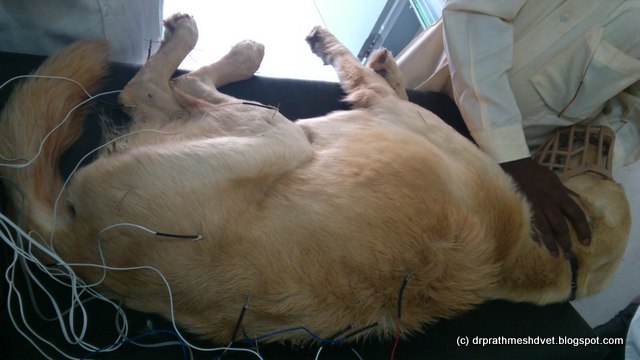
  • Ans.)   Your Acupuncturist will select the type of stimulation needed, he may use either or a combination of Electro-acupuncture, Aqua-puncture, Haemoacupuncture, Moxibustion, Pneuoacupuncture, Laser-puncture to enhance the effect of the session.

  • Q. )     How long will an Acupuncture Session last ?
  • Ans.)   An Acupuncture session can last from 15 minutes to 45 minutes depending on the condition and the method employed.

  • Q.)      How often will my pet be treated ?
  • Ans.)  Your pet may be treated once or twice a week in majority of the cases .

  • Q.)     How many sessions will be needed ?
  • Ans.)  Acupuncture is based on a science, so it is totally dependent on the case, the severity and how long is the disease going on for. No two cases can be compared as the Pathophysiology of the disease differs and Acupuncture therapy is "Tailor Made" for each and every individual pet. Acupuncture works on your body's response to the treatment,so it is a very individual based response. Some respond faster, some take longer. However as per our experience on an average you would require atleast 6 sessions to see a favorable response The Acupuncturist may be able to tell it to you when he examines the case.

  • Q.)      Can I perform Acupuncture on my pet ?
  • Ans.)   I'm sorry to say, but Acupuncture can be performed only by a trained Veterinary Acupuncturist. According to the law, Your Veterinary Acupuncturist should have formal training in the practice of acupuncture for animals.

  • Q.)   But I want to be an active participant in helping my pet recover what can I do as an owner ?
  • Ans.)  Your Acupuncturist can teach you some basic Acupressure techniques and a few physical exercises that you can easily perform at home and thus get a better and faster result. Implementation of diet plans,if recommended.

  • Q.)  How can I assure I play my part in helping my Pet get better ?
  • Ans.) This would probably be the most important part . When pets suffer from Neurological dysfunctions like Paralysis or some senior patients often loose control over urine and stools. They are unable to get up or walk. That is the time when they require most of your attention. Acupuncture would be a weekly or twice a week therapy. But the pet-parents need to take this in mind that the real care is to be taken by them during the rest of the week.

I've tried to put up most of the commonly asked questions, if you have any more questions, you can post a question as a comment below or feel free to send your queries to  
I would be glad to answer them.

Saturday, 19 November 2011

HOW DOES ACUPUNCTURE WORK ? - Scientific Basis Of Acupuncture : AcuMed Veterinary Specialty

Perhaps the most commonly asked question Acupuncturist have to face...
"How does Acupuncture Work " . Here I try to explain the Scientific Basis of Acupuncture.


Modern experiments have shown that Acupuncture points occur where nerves penetrate tissue planes or where nerves, themselves divide. 
There are 4 major types of Acupuncture points.
  1. Type - I (motor) points are most points are most common and exist where Nerves penetrate muscles.
  2. Type - II points are located where Nerves  intersect on the dorsal and ventral midlines of the body.
  3. Type - III points are located where superficial nerves branch.
  4. Type - IV points are located where nerves penetrate tendons ( Golgi Tendon Organ)
Most Acupuncture points are located at areas of low electrical resistance and high electrical conductance of the skin.  Deep into the point,there are accumulations of free nerve endings, small arterioles,veins,lymphatics and tissue mast cells. 

LOCAL EFFECTS OF ACUPUNCTURE :

When a needle is placed in an Acupuncture point , there is local tissue micro-trauma which activates Hageman s' tissue factor XII. This inturn results in the activation of local coagulation cascade and the complement cascade, leading to the production of plasminogen , protein kinins and prostaglandins . Further the trauma causes mast cell degranulation which releases histamine,heparin, proteases and bradykinin. 
Thus the local effect of Acupuncture involves in setting up a micro inflammatory process which results in increased tissue blood perfusion , increased immune responsiveness, relaxation of muscles and tissues in the area. To sum it up this pic explains how local effects of Acupuncture needle insertion.


SEGMENTAL AND SUPRASEGMENTAL RESPONSES :

PAIN MANAGEMENT : Acute pain is mediated by A delta fibers which are myelinated and are fast conducting, in muscles they are categorized as Type II & Type III fibers. The purpose of these fibers is to signal potential or actual tissue damage. Where as C fibers are unmyelinated and slow conducting . C fibers conduct chronic pain.


When an Acupuncture point is stimulated , as discussed above it sets up a same response the same response in the brain and body that would be stimulated by a potential or actual tissue damage without that damage actually occurs , because this potential damage is more important to the body than the pain from the chronic condition, the acupuncture stimulus from A delta fibers get a priority in terms of recognition . A delta fibers stimulated by needle activate the interneurons in the dorsal horn that produce Enkephalins. These Enkephalins are inhibitory to any C fiber activity going on in the same dorsal horn. Thus C fiber pain is "switched off" or more accurately its impulse importance is decreased thus controlling Pain at the level of the Spinal Cord.

EFFECTS BEYOND THE DORSAL HORN OF THE SPINAL CORD : After synapsing in the dorsal horn, A delta fiber transmission continues upto the spinaothalamic tracts to the BRAIN. Various interactions at this level stimulate release of the following neurotransmitters.
  1. Beta Endorphin from Peri Aquaductal Grey 
  2. Nor-Adrenaline indirectly from the gigantocellular reticular region.
  3. Serotonin from the raphae nucleus magnus of the Medulla Oblongata..
  4. Oxytocin from Vagal Nucleii and Adernocorticotrophic Hormone from the pitutary gland.
Some of these neurotransmitter act humerally , some via descending inhibitory control system. These systems 'damp down' the pain perception at every spinal segment by inhibiting the transmission of painful stimulii by various mechanisms. Serotonin and Nor-Adrenaline are involved with and potentiate the effects of descending  inhibitory control and thus inhibiting pain.

EXPERIMENTAL EVIDENCE :
In an experiment using Manganese enhanced Functional MRI (f-MRI) visual effects were seen  in human and animal neural tissues.
above pic : fig A : Baseline ;
                  fig B : Mannitol Infusion
                  fig C : Manganese infusion
                  fig D : After Electro-Stimulation of an Acupuncture point GB-34.


ACTIVATION OF CORTEX IS ACUPUNCTURE SITE SPECIFIC
                                           
Stimulation of different Acupuncture points activates different areas in the cortex.


ANALGESIC V/S NON ANALGESIC ACUPUNCTURE POINTS :


In a separate study Analgesic acupuncture points were compared to the non analgesic points .
  • Analgesic acupuncture points altered Brain regions involved in pain modulation like Peri Aquaductal grey, Hypothalamus and Thalamus.
  • Non- analgesic points did not activate the same areas
 A COMMON MISCONCEPTION THAT ACUPUNCTURE WORKS ONLY IN PAIN CONTROL IS NOT TRUE AS NUMEROUS RESEARCHES HAVE PROVED THE NON-ANALGESIC PROPERTIES OF ACUPUNCTURE  & ON THE CONTRARY TO  A FEW MYTHS THAT ACUPUNCTURE IS NOTHING MERELY BUT A PLACEBO HAS BEEN PROVED WRONG BY THE FACT THAT THERE IS NO PLACEBO IN ANIMALS. 

 NON ANALGESIC PROPERTIES OF ACUPUNCTURE
There have been several researches to demonstrate the non analgesic properties of Acupuncture . I have listed a few,
  1. The Acupuncture point Pericardium-6 (PC-6) is well known for its anti-nausea effects and has been shown to be helpful in controlling postoperative and postchemotherapy nausea in human. A new research showed it resulted in decrease in lipid peroxidation of the heart and increase in coronary flow and stabilization of cardiac rhythm.
  2. Governing Vessel-26 (GV-26) when rapidly manipulated results in release in Epinephrine,which results in revival of a patient. In an experiment in a group of dogs with Hyopvolemic shock 75 % of the dogs who received stimulation of GV-26 acupoint survived compared to 100% mortality in the control group.
  3. Speeds recovery from Paralytic stroke as acupuncture provides an enriched sensory environment and has been showed that animals that receive Western medicines along with Acupuncture have a better recovery than those who receive only Western Medicine .
  4. Autonomic modulation in Detrusor muscle inability in human, Acupuncture was shown to have the same effect as the standard treatment drug ,Oxybutinin.
  5. Governing Vessel-14 (GV-14), LI-11 have shown to have a role in Immunomodulation .
  6. Promotes Wound healing by second intention to speed up Acral Lick lesions and to improve healing of ulcers.
  7. Management of Behavioural problems by release of neurotransmitters Serotonin and Nor-Adrenaline.
  8. DERMATOLOGY PROBLEM management by reducing Pruritis as "ITCH" is caused by C-fiber stimulation and inhibition of C-fiber thus prevents self-mutilation in addition to the immunomodulatory effects promote faster recovery.
  9. Governing Vessel-4 (GV-4) has shown to have an effect on the delayed Hypersensitivity reaction by a mechanism involving release of Opoids.


CONCLUSION : The effects of Acupuncture cannot be explained by a single mechanism. What starts as a Local event spreads by the nervous system to affect most of the body . Ultimately the Nervous system effects create changes in the Endocrine system and Immune-System. While the knowledge and the theory behind application of Acupuncture in a clinical setting may be derived from antiquity , it has been modified and improved over the years.


The Western Veterinary Medicine & the Traditional Chinese Veterinary Medicine have their own strengths and weakness . However they can be successfully Integrated so as to Multiply their strengths and Divide their weakness.  

INTEGRATIVE MEDICINE CAN BE THE FUTURE OF VETERINARY SCIENCES .


"A MIND THAT OPENS TO NEW IDEAS, NEVER RETURNS TO ITS ORIGINAL SIZE " 
                               - Albert Einstein